
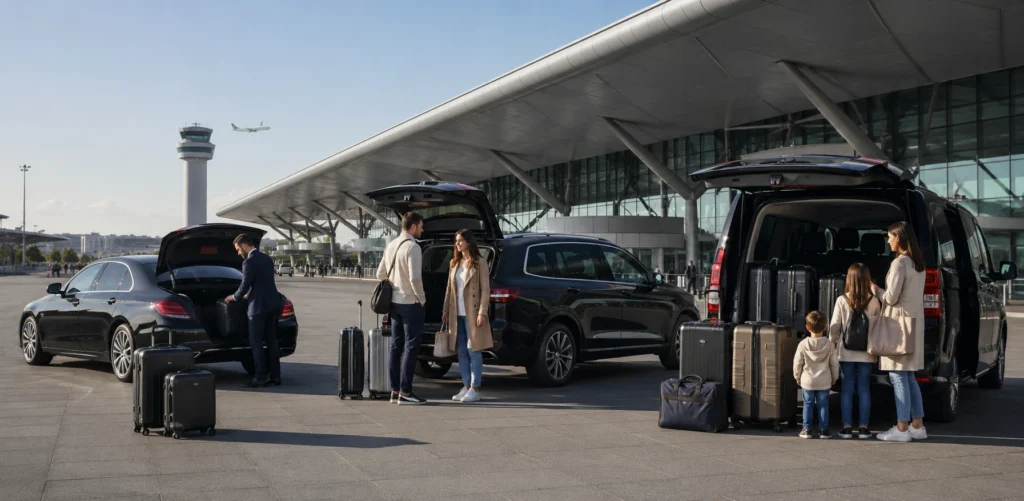
The right airport taxi depends on both your passenger count and your luggage. A vehicle can have enough seats for everyone but still have too little boot or storage space for every suitcase.
The safest way to judge airport taxi luggage capacity is to count five things before booking:
- Passengers
- Large suitcases
- Cabin bags
- Child equipment
- Oversized or unusual items
Good taxi luggage capacity planning is therefore about more than asking how many people a vehicle seats. Bag size, seating layout and bulky equipment can change which vehicle is suitable.
The Quick Rule: Count Bags as Well as Passengers
Seat count is only one limit. Luggage space is another.
A vehicle may legally seat four passengers without having enough room for four large hard-shell suitcases in the boot. Larger vehicles can create the opposite problem. As more passenger seats are occupied, some layouts leave less usable space for baggage.
Vehicle models also differ within the same broad category.
That means “saloon”, “estate”, “MPV” or “8-seater” should be treated as a starting point rather than a universal luggage guarantee.
Large cases fill space quickly. Cabin bags, backpacks, pushchairs and equipment also take up usable room even when they seem small individually.
Luggage should not be planned around passengers holding bags on their laps for an airport journey.
The most useful information you can give the operator is straightforward:
- How many people are travelling
- How many large cases you have
- How many cabin bags you have
- Whether you are carrying child equipment
- Whether any item is unusually long, wide or bulky
Tell the operator exactly what is travelling with you rather than choosing a vehicle from passenger count alone.
Airport Transfer Vehicle Size by Vehicle Type
The correct airport transfer vehicle size depends on passengers, luggage dimensions and the actual vehicle assigned.
Use this table as a selection guide rather than a fixed suitcase-capacity guarantee.
| Vehicle | Usually best suited to | Luggage consideration |
| Saloon | Solo travellers, couples, smaller parties | Less boot space than larger categories |
| Estate | Families or passengers needing more cargo room | More useful where luggage volume is the main issue |
| MPV / People Carrier | Families and small groups | Luggage room can decrease as more seats are occupied |
| Larger / 7- or 8-seat vehicle | Bigger groups | Full passenger loads can significantly reduce storage space |
Exact luggage capacity depends on the individual vehicle and the dimensions of the bags being carried.
Before choosing, you can view the Virginia Water Cars fleet and provide the complete passenger and luggage requirement when booking.
This is more reliable than assuming that every vehicle within one category has the same boot or cabin layout.
Saloon Cars: Best for Smaller Loads
A saloon car is generally most suitable for smaller travelling parties with a moderate amount of luggage.
Typical users include:
- Solo travellers
- Couples
- Business travellers
- Small families travelling lightly
- Passengers carrying cabin bags and a limited number of larger cases
The main limitation is luggage volume.
A saloon can have enough passenger seats while still being unsuitable for a group where every traveller has a full-size suitcase.
For example, four people travelling with only small bags create a very different load from four people returning from a long-haul holiday with large checked cases.
Do not assume that an empty passenger seat automatically solves the problem either. Suitcases need to be carried safely within the vehicle’s available storage area.
If your group is close to the passenger limit and everyone has substantial luggage, a larger boot or larger vehicle category can be more appropriate.
The exact answer depends on the actual vehicle assigned, so describe the luggage rather than relying on a generic saloon-capacity figure.
Estate Cars: More Boot Space Without a Larger Passenger Vehicle
An estate car is useful when the main problem is luggage space rather than needing many more passenger seats.
The longer rear cargo area can make it more suitable for:
- Families
- Travellers with several checked bags
- Couples carrying bulky luggage
- Folded pushchairs
- A mixture of cabin bags and larger suitcases
An estate can be particularly useful for airport trips where a saloon has enough seats but insufficient boot space.
That distinction matters.
The reason to move from a saloon to an estate is often not that more people are travelling. It is that the same number of passengers are carrying more luggage.
Bag shape still matters.
Several rigid hard-shell cases can use the available area differently from soft bags that can fit around one another.
Pushchairs and other equipment also reduce the space available for suitcases.
An estate should therefore be selected according to the whole load, not simply because it is “bigger”.
Provide the operator with the passenger count and a realistic list of bags before the journey is confirmed.
MPVs and People Carriers: Think About Seats and Bags Together
An airport taxi for luggage involving families or small groups often needs an MPV or people carrier, but the relationship between seats and storage still matters.
MPVs can provide:
- Additional passenger seating
- More flexible cabin layouts
- Greater space for families
- More room for children and luggage
- Better options for mixed passenger and cargo needs
The important trade-off is simple:
As more seats are occupied, luggage space can fall.
A six- or seven-seat people carrier should not automatically be interpreted as a vehicle for six or seven passengers plus the same number of large suitcases.
Rear seating rows can occupy part of the area that might otherwise be used for baggage.
This matters particularly for:
- Families with pushchairs
- Groups with large checked cases
- Passengers carrying sports equipment
- Travellers returning from long holidays
- Groups carrying both suitcases and cabin bags
The correct vehicle therefore depends on how many seats are being used and how much cargo must still fit around them.
When booking, give both numbers together.
Do 7- or 8-Seater Vehicles Have Space for Everyone’s Suitcases?
Not necessarily.
A seven- or eight-seat vehicle describes passenger seating capacity. It does not automatically guarantee space for seven or eight full-size suitcases at the same time.
Large group vehicles often use rear seating rows that share the overall cabin area with luggage storage.
That creates an important difference between these two journeys:
Eight passengers with small backpacks
and
Eight passengers with eight large checked suitcases
The passenger count is identical, but the luggage requirement is completely different.
Large family holidays and group airport bookings therefore need more careful planning than simply requesting an “8-seater”.
Depending on the actual vehicle and luggage volume, the practical solution can involve:
- A larger-capacity vehicle
- A different seating configuration
- Reduced passenger load in one vehicle
- More than one vehicle
Do not assume which option is required yourself.
Provide the full passenger and luggage information and allow the operator to check the available arrangement.
The vehicle name tells you how many people can potentially sit inside. It does not tell you how much baggage can fit when every seat is occupied.
Not All Luggage Is the Same Size
A useful taxi luggage capacity estimate needs more detail than the number of bags.
“Four bags” can describe four small backpacks or four large checked cases. Those two loads take up completely different amounts of space.
Personal items
These include handbags, laptop bags and small backpacks. They still take up space, even when passengers expect to keep them close during the journey.
Cabin cases
Cabin cases are designed around airline hand-luggage dimensions, but their exact size still varies between brands and airlines.
Medium suitcases
These are common checked bags and take considerably more room than cabin cases.
Large suitcases
Full-size holiday cases use substantial boot space, especially when several are rigid hard-shell designs.
Oversized luggage
Anything unusually long, wide or awkwardly shaped needs separate consideration.
A much better luggage description is:
“2 large hard-shell suitcases, 2 cabin cases and 1 backpack”
rather than:
“5 bags”.
The more accurate your description is, the easier it is to assess whether the planned vehicle has enough usable storage space.
Hard-Shell Cases vs Soft Bags
Luggage shape matters almost as much as luggage count.
Hard-shell luggage
Hard-shell cases have fixed dimensions.
They do not compress when space becomes tight, although regular shapes can sometimes stack efficiently.
Several large rigid cases can fill a boot faster than passengers expect.
Soft bags and holdalls
Soft luggage is more flexible.
A holdall can sometimes fit around other bags or use spaces that a rigid suitcase cannot. That flexibility does not mean soft bags should be ignored when counting luggage. They still occupy real storage space and can become bulky when fully packed.
Do not plan an airport journey around squeezing bags into unsafe spaces.
The useful question is not only “how many bags do we have?”
It is also: “What shape and size are the largest bags?”
Travelling with Children? Count More Than the Suitcases
Families often need more vehicle space than the passenger count alone suggests.
A family journey can include:
- Child seats
- Booster seats
- Pushchairs
- Travel cots
- Baby bags
- Large suitcases
- Cabin luggage
- Toys or travel accessories
Child seats occupy passenger seating positions, while pushchairs and travel equipment use storage space.
A family of four travelling for a two-week holiday can therefore have a much larger total load than four adults travelling for a short business trip with hand luggage.
Pushchair design also matters.
Some fold into compact shapes, while others remain long or bulky even when collapsed.
Families should provide both the child-seat requirement and the luggage details when booking.
Virginia Water Cars’ child seat and seat belt regulations provide additional guidance for planning journeys with younger passengers.
Do not assume that a child seat or suitable pushchair space will automatically be available without being discussed before travel.
Golf Clubs, Wheelchairs and Oversized Items
Unusual items can determine the vehicle before ordinary suitcases do.
Examples include:
- Golf clubs
- Folded wheelchairs
- Mobility aids
- Ski or snowboard bags
- Musical instruments
- Large pushchairs
- Exhibition equipment
- Display materials
- Large boxes
- Other sports equipment
These items can be long, rigid or difficult to stack with normal baggage.
A golf bag, for example, can fit lengthways in some vehicles but interfere with the way suitcases would otherwise be loaded.
Wheelchairs and mobility equipment vary greatly in size and whether they fold. Do not assume that every oversized item can be carried in every vehicle category.
When booking, tell the operator:
- What the item is
- How many you have
- Whether it folds
- Whether it is rigid
- Its approximate dimensions when unusually large
The single largest item can determine the vehicle you need.
That is why listing “three suitcases plus golf clubs” is more useful than simply saying “four pieces of luggage”.
What Size Taxi for Airport Travel with Four Passengers?
The answer to what size taxi for airport travel with four passengers depends on what those four people are carrying.
Four passengers with hand luggage only
A smaller vehicle can be suitable when all four passengers travel lightly, and the actual assigned vehicle has sufficient space.
Four passengers with several large suitcases
An estate or larger option can be more appropriate because luggage volume becomes the main restriction.
Four passengers with cases plus a pushchair or golf clubs
Move the decision towards the total cargo requirement rather than passenger count. A larger vehicle may be needed even though only four seats are occupied.
Four passengers with unusually large luggage
Confirm the exact requirement before booking.
Do not rely on a generic vehicle-category assumption.
The correct choice depends on:
- Suitcase size
- Cabin-bag count
- Bulky equipment
- Child-seat requirements
- The actual vehicle model
Four passengers is therefore not enough information on its own. Tell the operator what all four passengers are bringing with them.
What Should You Tell the Operator When Booking?
Give a complete passenger-and-luggage picture when arranging the transfer.
Include:
- Number of adults
- Number of children
- Child seats required
- Number of large suitcases
- Number of medium cases
- Number of cabin bags
- Backpacks or laptop bags
- Pushchairs
- Wheelchairs or mobility aids
- Golf clubs
- Sports equipment
- Oversized items
- Approximate dimensions of unusually large objects
Also provide the pickup location and airport or final destination.
This matters for Heathrow, Gatwick, Luton, Stansted and London City journeys just as much as for any other airport transfer.
If you are unsure which vehicle to choose, a clear luggage description is more useful than guessing.
The operator can compare the requirement against the actual vehicle options rather than relying on a simplified category label.
Passengers planning a Heathrow journey can also review the dedicated Heathrow Airport transfer service when arranging the vehicle and airport details together.
What If Your Luggage Changes After Booking?
Contact the operator when your passenger or luggage requirement changes materially after the original booking.
Common changes include:
- Adding another suitcase
- Shopping increasing the bag count
- Another passenger joining
- Adding a pushchair
- Bringing golf clubs
- Adding sports equipment
- Changing from cabin bags to full-size cases
One extra bag can be harmless in one vehicle and enough to create a space problem in another.
Do not wait until the driver arrives to mention a major change.
The vehicle may need to be reassessed.
The same applies when another passenger joins the journey. An additional person uses a seat that can affect both passenger comfort and the storage configuration.
Contact the operator as early as practical and explain exactly what has changed.
The booking can then be checked against the new total passenger and luggage load.
A previously suitable vehicle does not automatically remain suitable after the journey requirements change.
Choose the Right Vehicle Before Airport Day
The simplest way to avoid a luggage problem is to arrange the vehicle around the real passenger and baggage requirement before travel day.
Count:
- People
- Large cases
- Cabin bags
- Child equipment
- Bulky or unusual items
Then compare that requirement with the actual available vehicle rather than guessing from a category name.
Virginia Water Cars offers a range of fleet options for airport journeys, including transfers to Heathrow and other London airports.
You can view the fleet before booking or provide your luggage details when requesting a quote.
When the load is unusual, a detailed description helps the booking team assess what is appropriate.
Get an instant quote once you know the passenger count and luggage requirement.
The correct vehicle is the one that accommodates the people and the actual load, not simply the one with enough advertised seats.
Frequently Asked Questions
How much luggage can you take in an airport taxi?
It depends on the vehicle model, the number of passengers, and the dimensions of the luggage. Count large cases, cabin bags and bulky items separately rather than assuming every taxi has the same baggage capacity.
How many suitcases fit in a saloon taxi?
There is no universal figure that applies to every saloon. Specific models have different boot shapes and capacities. A saloon is generally better suited to smaller parties and lighter luggage, but the exact load should be confirmed before travel.
What vehicle is best for four passengers with four large suitcases?
An estate or larger vehicle can be more suitable than a standard saloon, but the exact answer depends on case dimensions and the actual vehicle available. Provide the full luggage list before booking.
Will an 8-seater take eight passengers and eight suitcases?
Not automatically. The rear passenger seating can reduce luggage room, so a full eight-person load with eight large cases may require a different arrangement or additional vehicle capacity.
Do cabin bags count as luggage when booking a taxi?
Yes. Cabin bags, backpacks and laptop cases all occupy usable space. Include them in the luggage information even when they are smaller than checked suitcases.
Does a pushchair affect the vehicle size I need?
It can. A folded pushchair uses boot or cabin storage space and can significantly change the total load when combined with several large suitcases.
Can airport taxis carry golf clubs?
Potentially, depending on the vehicle and size of the golf equipment. Tell the operator how many golf bags you have and include any additional luggage so the complete load can be assessed.
What should I do if I do not know which vehicle to choose?
Provide the number of adults and children, plus a detailed list of large cases, cabin bags, pushchairs, sports equipment and other bulky items. The operator can then advise based on the actual available fleet.