
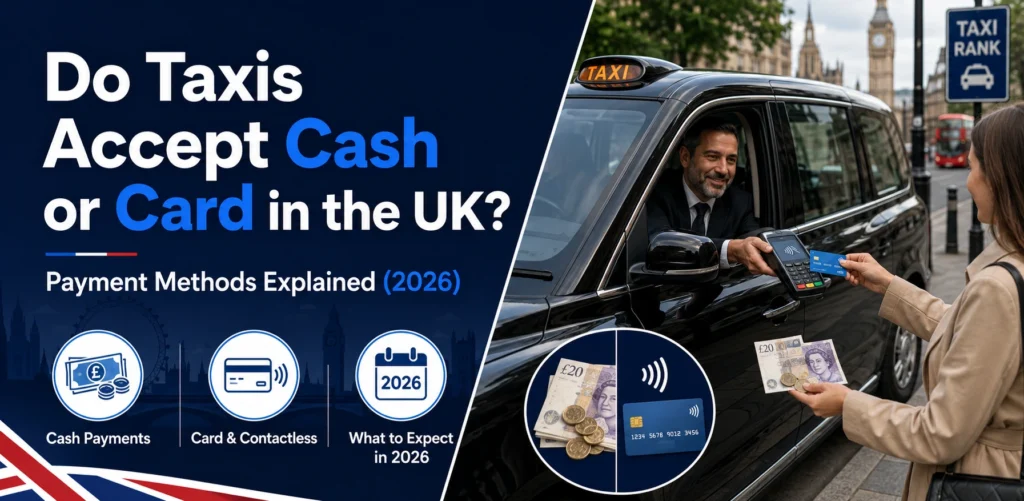
You have just landed at Heathrow. Your taxi is waiting. You reach for your wallet and wonder: Does this driver take card? Or do you need cash?
It is one of the most common questions passengers ask, and the answer depends on the type of taxi, the operator, and how you booked. This guide covers every payment method accepted by taxis and private hire vehicles in the UK in 2026, the rules drivers must follow, and what to do when something goes wrong at the end of a journey.
Most taxis and private hire vehicles in the UK accept both cash and card. Licensed black cabs in London are legally required to accept card payments. On the other hand, private hire vehicles, including minicabs, airport taxis, and pre–booked operators, almost all accept card, and many now offer app-based and online payment too.
The safest approach is always to confirm the accepted payment methods at the time of booking. Before you travel. Not at the end of the ride.
Cash vs Card vs App: Which Is Best for Your Journey?
| Payment method | Best for | Watch out for |
| Cash | Short local trips, rural areas, quick journeys | No record, need change, easy to lose |
| Card (in vehicle) | Most journeys, last-minute bookings | Machine failures, signal issues |
| App / online pre-payment | Airport transfers, pre-booked journeys | Requires booking in advance |
| Corporate account | Business travel, regular journeys | Requires account setup with operator |
3 Common Taxi Payment Methods in the UK
1. Cash
Cash is still widely accepted across the UK, particularly by licensed taxis in smaller towns, rural areas, and older fleets. For short local journeys. A quick trip to the station or a nearby town centre. Cash is straightforward and quick.
Pros:
- Simple and immediate, no technology required
- No card machine needed
- No processing fees
Cons:
- Requires exact change or the driver having float
- No automatic payment record unless you ask for a receipt
- Easy to miscalculate on metered fares
Cash works well for local, low-fare journeys. For airport transfers or longer trips with a pre-agreed fixed fare, card or app payment is more practical.
2. Card Payment
Card payment is now standard across licensed taxis and private hire vehicles in the UK. As per Transport for London (TfL), all licensed taxis must have a card payment device installed in the passenger compartment of the vehicle. Drivers cannot refuse card payment.
UK taxis accept:
- Debit cards
- Credit cards
- Contactless payment (tap to pay)
- Apple Pay and Google Pay on most modern terminals
An important rule that many passengers do not know: it is an offence under TfL regulations for any private hire operator or taxi company to charge extra because you are paying by card. No surcharge is permitted for debit or credit card payments. If a driver asks you to pay more for using a card, they are not following the rules.
3. App and Online Payment
If you book your taxi through an operator’s app or website, payment is handled automatically. You enter your card details at booking, the fare is fixed, and payment is processed at the end of the journey, or in advance, depending on the operator.
When booking via app or online, your options typically include:
- Card pre-payment at the time of booking (fare locked in, nothing to pay on the day)
- Card payment at the end of the journey via the app
- Corporate account invoicing for business account holders
Virginia Water Cars accepts card payment online at the time of booking, locking in the fixed fare. Cash payment is also accepted at the end of the journey. No card surcharge applies either way.
Taxi Fare Rules Every Passenger Should Know
UK taxi and private hire regulations exist to protect passengers. Here are the key rules that apply to payment specifically:
- Black cabs (hackney carriages) operate on metered fares. The meter runs from the moment you get in, and the fare is whatever it reads on arrival.
- Private hire vehicles (PHVs/minicabs) must provide a fixed fare in advance. The price is agreed before the journey starts and cannot change.
- Local councils set maximum fare limits for licensed taxis in their area. Operators cannot charge above these limits.
- Drivers must inform passengers of the accepted payment methods. You are entitled to ask before the journey begins.
- No card surcharge is permitted for TfL-licensed operators. Charging extra for card payment is a regulatory offence.
The fixed fare rule for private hire vehicles is particularly important for airport transfers. Unlike a black cab meter that climbs in traffic, a pre-booked fixed fare from Virginia Water to Heathrow stays at the agreed price regardless of road conditions.
Step-by-Step: How to Pay for a Taxi Without Problems
Follow these 4 steps to avoid any awkward moments at the end of a journey:
Step 1. Confirm the payment method before you book
Ask: “Do you accept cards?” or check the operator’s website. For pre-booked operators, this is usually stated clearly.
Step 2. Confirm the fare structure
Is it a fixed fare or a metered fare? For private hire vehicles, the fixed fare should be given before the journey starts. Never get into a private hire vehicle without knowing the fare in advance.
Step 3. Keep a backup payment method
Have either some cash or a card with you regardless of what the driver accepts. Card machines occasionally fail, and signal issues can affect contactless payments in some areas.
Step 4. Request a receipt if you need one
For expense claims, corporate travel, or simply your own records. Ask for a receipt before you pay. Most operators can email one automatically if you booked online.
Common Payment Problems and How to Avoid Them
Even with modern payment methods, things occasionally go wrong. Here are the 4 most common issues passengers face:
- Card machine not working: Network or hardware failure means the driver cannot process card payment
- Signal issues: Contactless and chip-and-pin both require a signal; rural areas and underground car parks can cause problems
- No exact change: The passenger has a £50 note for a £12 fare; the driver cannot change it.
- Fare confusion: The passenger expected a fixed fare, but the driver is running a meter, or vice versa/
How to avoid all 4:
- Pre-book with a licensed operator who confirms the fare and payment method at booking.
- Carry a small amount of cash as backup. £20 is usually enough for most journeys.
- Book online and pre-pay where possible. This eliminates all end-of-journey payment issues.
- Use operators with app tracking and digital receipts. Any dispute is resolved with a booking reference.
The Gap Most Passengers Miss: Unregulated Operators
Here is something the reference articles rarely cover, and it directly affects your money.
Not all vehicles offering taxi-style services in the UK are licensed. Unlicensed operators, also called “pirate taxis,” are not regulated by any council or licensing body. They are not required to follow fare rules, accept card payment, provide receipts, or carry hire and reward insurance.
If you accept a ride from an unlicensed driver, particularly at airport arrival halls, train stations, or busy event venues, you have no legal protection if:
- The driver charges you far more than agreed
- The card machine is “broken,” and cash only is demanded
- No receipt is available
- An accident occurs (the vehicle’s insurance may not cover passengers)
3 ways to identify a licensed operator:
- Ask to see the driver’s private hire licence (carried at all times by law)
- Check the vehicle for a council-issued licence plate or disc (usually displayed in the windscreen or on the rear)
- Book through a named operator’s website or app. Not from someone who approaches you at the terminal
Virginia Water Cars is licensed by Runnymede Borough Council. Every driver carries a DBS enhanced certificate and private hire licences and operates a fully insured vehicle. Payment by card or cash is accepted, with no surcharge, and a receipt is provided for every journey.
Payment at Virginia Water Cars: How It Works
- Online booking: Pay by card at the time of booking. The fare is fixed and confirmed immediately.
- On the day: Cash or card accepted. Driver carries a card terminal.
- Card surcharge: None.
- Receipt: Emailed automatically for online bookings; available on request for cash payments.
- Corporate accounts: Available for business travellers. Monthly invoicing, no per-journey card payments required.
Frequently Asked Questions
Do taxis in the UK take card payments?
Yes. All licensed taxis in the UK accept card payments. TfL-licensed taxis in London are legally required to have a card payment device in the passenger compartment. Private hire operators outside London are not subject to the same legal requirement, but the vast majority accept card as standard.
Can a taxi driver refuse to accept my card?
A TfL-licensed black cab driver cannot legally refuse card payment. For private hire operators outside London, check at the time of booking. Most accept card, but it is worth confirming.
Can a taxi charge me more for paying by card?
No. TfL regulations make it an offence for licensed operators to charge a surcharge for card payment. If an operator adds a card fee, they are not following the rules, and you should report it to the licensing authority.
What if the card machine is broken?
Ask the driver to contact their operator. Many can take card payment over the phone or via a payment link sent by SMS. As a backup, carry £20–£30 in cash for shorter journeys.
Is it better to pay cash or card for a taxi?
For short local trips, cash is simple and quick. For airport transfers, long-distance journeys, or any pre-booked fixed-fare trip, card or app pre-payment is more reliable. There is no end-of-journey payment to handle, and the fare is locked in before you travel.
Does Virginia Water Cars accept cash?
Yes. Virginia Water Cars accepts both cash and card. No surcharge applies to either method. For pre-booked journeys, card payment at booking is the easiest option. The fare is confirmed, paid, and nothing changes on the day.