
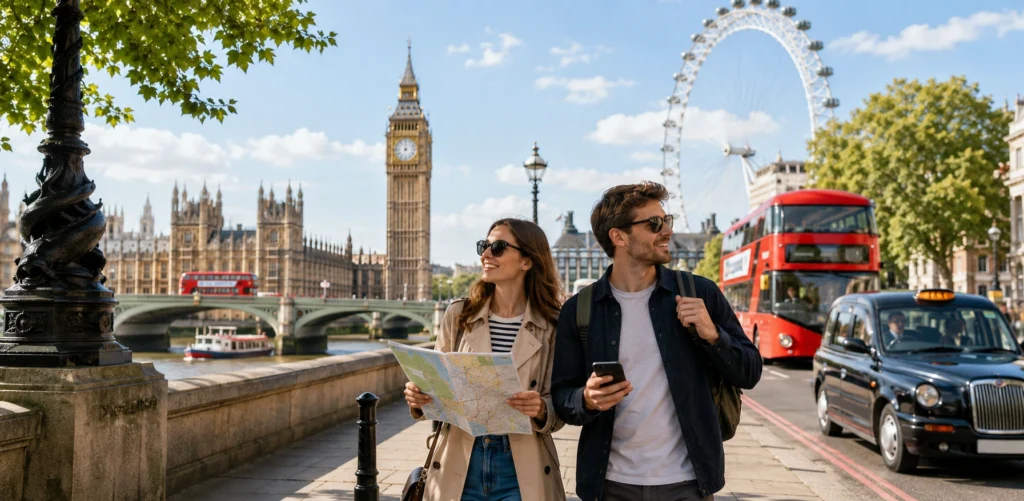
If you only have one day in London, focus on Westminster, Buckingham Palace, Trafalgar Square, Covent Garden, St Paul’s Cathedral and Tower Bridge rather than trying to see everything.
London rewards walking because many famous landmarks sit close together, but walking every mile is not the best use of a limited day. A practical London one-day itinerary combines short walks through sightseeing clusters with faster transport between areas that are farther apart.
One day is enough to see many of London’s defining sights. It is not enough to properly explore several museums, palaces, markets, and paid attractions at the same time.
The goal is to see the highlights without turning your visit into a race.
London One Day Itinerary at a Glance
The most efficient route moves from Westminster through Royal London, continues into the West End, then shifts east towards St Paul’s Cathedral and Tower Bridge.
| Time | Area | Main sights |
| Morning | Westminster | Big Ben, Parliament, Westminster Abbey |
| Late morning | Royal London | St James’s Park, Buckingham Palace |
| Midday | Trafalgar/Covent Garden | Trafalgar Square, Covent Garden |
| Afternoon | City of London | St Paul’s Cathedral |
| Late afternoon | Thames | Tower Bridge, Tower of London |
| Evening | Central London | Soho, Covent Garden or South Bank |
A useful route is:
Westminster
↓
St James’s Park
↓
Buckingham Palace
↓
Trafalgar Square
↓
Covent Garden
↓
St Paul’s Cathedral
↓
Tower Bridge
↓
South Bank, Soho or Covent Garden
Exact timing depends on your walking pace, weather, meal stops, traffic, queues and whether you enter any attractions.
Trying to visit the inside of every major landmark will quickly make this schedule unrealistic. Choose one or two attractions for a full visit and treat the others as exterior sightseeing stops.
Morning: Start Your London Sightseeing Itinerary in Westminster
Start your London sightseeing itinerary in Westminster because several of London’s most recognisable sights sit within a compact area.
Big Ben and the Houses of Parliament
Big Ben and the Houses of Parliament can be viewed together around Parliament Square and Westminster Bridge.
You do not need a long stop to appreciate the setting. Walk around Parliament Square, take in the Palace of Westminster and move towards the Thames for a broader view.
Westminster Bridge also gives you a useful perspective across the River Thames towards the London Eye.
Westminster Abbey
Westminster Abbey is only a short walk away.
Its exterior is worth including even when time is limited. Entering the Abbey is a different commitment because a full visit, security procedures and possible queues can consume a substantial part of your morning.
If Westminster Abbey is one of your main reasons for visiting London, go inside and shorten another part of the itinerary.
If your priority is covering London’s major landmarks, see the exterior and continue.
Westminster Bridge and the London Eye
Walk onto Westminster Bridge for views of Parliament, the Thames and the London Eye.
The London Eye is optional rather than essential for this itinerary.
It can provide wide city views, but any ticketed attraction takes time away from other stops. With just one day available, choose paid experiences selectively.
A useful rule is simple: one or two attraction interiors can fit comfortably into the day. Trying to enter everything cannot.
Walk Through St James’s Park to Buckingham Palace
From Westminster, continue towards St James’s Park and Buckingham Palace.
This is one of the best parts of Central London to cover on foot because several important sights are close together and the walk itself forms part of the experience.
You can travel past or near:
- Birdcage Walk
- St James’s Park
- Buckingham Palace
- Victoria Memorial
- The Mall
St James’s Park provides a quieter break between Westminster’s busy streets and Buckingham Palace. You can cross through the park rather than treating it as a separate attraction requiring a long visit.
At Buckingham Palace, allow time for photographs and a walk around the Victoria Memorial.
The Changing of the Guard can be worth seeing when its schedule fits your day, but do not build the entire itinerary around it unless it is a priority. Waiting for a specific ceremony can take a significant portion of a short London visit.
After Buckingham Palace, continue along The Mall towards Admiralty Arch and Trafalgar Square.
This entire Westminster-to-palace section rewards walking. Taking transport between every stop would save very little time and remove much of the street-level experience.
Continue to Trafalgar Square and Covent Garden
From Buckingham Palace, walk along The Mall towards Trafalgar Square.
The route passes Admiralty Arch before opening into one of Central London’s best-known public spaces.
Trafalgar Square
Trafalgar Square is a useful short stop rather than somewhere you need to spend an hour.
You can see Nelson’s Column, the fountains and the National Gallery exterior while staying directly on the route towards Covent Garden.
The National Gallery is free to enter, but a serious visit can easily expand far beyond the available schedule.
Go inside only when art is one of your main priorities.
Leicester Square or direct to Covent Garden?
Leicester Square can be added as a small detour, particularly for visitors interested in London’s entertainment district.
Otherwise, continue towards Covent Garden.
Covent Garden
Covent Garden works well as the midday break in this one-day in London plan.
It combines a central location with cafés, restaurants, shops and street activity, so you can eat without travelling far away from the sightseeing route.
Keep lunch flexible.
A long reservation or elaborate meal can easily consume time that would be better used later at St Paul’s or Tower Bridge.
After lunch, this is also a good point to stop walking continuously and use transport for the move towards the City of London.
Afternoon: Move to St Paul’s Cathedral
St Paul’s Cathedral marks the transition from the West End to the City of London.
Walking from Covent Garden to St Paul’s is entirely possible, but it is also one of the places where a Tube, taxi or pre-arranged vehicle can preserve sightseeing time.
Visitors who enjoy walking and have comfortable footwear can continue on foot.
Travellers with children, limited mobility or a tighter schedule can save energy for the areas around St Paul’s and the Thames by using transport.
At St Paul’s, decide whether you want an exterior stop or a full visit.
The cathedral is one of London’s most important landmarks, but entering it changes the rest of your afternoon schedule.
For a faster visit:
- View St Paul’s from the surrounding streets.
- Walk around the cathedral exterior.
- Continue towards Millennium Bridge.
- Cross or partially explore the Thames-side route.
Millennium Bridge creates a direct visual connection between St Paul’s and Tate Modern on the opposite bank.
Even without entering Tate Modern, this section provides some of the strongest river and skyline views on the route.
Finish the Main Sightseeing Route at Tower Bridge
Tower Bridge is the natural final major landmark in this London one-day itinerary.
The area combines several important London entities within a manageable sightseeing cluster:
- Tower Bridge
- Tower of London
- River Thames
- City skyline
- Thames-side walkways
One common first-time visitor mistake is confusing Tower Bridge with London Bridge.
They are separate bridges.
Tower Bridge is the famous Victorian bascule bridge with two towers. London Bridge lies farther west and has a much simpler appearance.
If time permits and the Tower of London is a major priority, you can visit the historic site properly.
If not, seeing the Tower of London exterior and continuing towards Tower Bridge preserves the landmark within the schedule without sacrificing the remainder of the day.
Walk along the riverside, photograph Tower Bridge and cross the bridge if time and energy allow.
By this point you have travelled through several distinct parts of London rather than spending the whole day in a single neighbourhood:
Westminster > Royal London > West End > City of London > Thames
That gives a first-time visitor a much broader impression of the city than trying to spend several hours inside each attraction.
What Should You Do in the Evening?
Finish the day somewhere that suits what you want from the evening rather than adding another major attraction.
Three areas work particularly well.
Soho and Chinatown
Choose Soho or Chinatown when you want restaurants, bars, evening atmosphere and busy Central London streets.
This is the strongest option for travellers who want the sightseeing day to turn naturally into dinner or nightlife.
Covent Garden
Return to Covent Garden when you want restaurants, theatre activity and a central area that remains easy to navigate.
It also works well if your hotel is in the West End.
South Bank
Choose the South Bank when you would rather finish with a quieter riverside walk.
The Thames, illuminated bridges and views towards Westminster create a different atmosphere from the daytime sightseeing route.
There is no requirement to finish exactly where you started. Your hotel, onward transport and airport plans can determine the most practical final stop.
When to Walk and When to Take a Taxi or Tube
The most efficient one-day London tour uses different transport modes for different parts of the route.
Walking makes sense when attractions are clustered together.
Walk between
- Westminster and St James’s Park
- St James’s Park and Buckingham Palace
- Buckingham Palace and Trafalgar Square
- Trafalgar Square and Covent Garden
- Short sections along the Thames
These walks are part of the sightseeing experience rather than wasted travel time.
Use the Tube when
- Traffic is heavy
- Your destination sits near a convenient station
- You have light luggage
- You are comfortable navigating London’s rail network
- You need to cross a larger distance quickly
Use a taxi or private transfer when
- Several people are travelling together
- Children are part of the group
- Walking distances need to be reduced
- Someone has limited mobility
- You are carrying substantial luggage
- The weather makes long walks difficult
- A fixed airport return time matters
- You need direct movement between distant stops
Public transport can be the quickest option for some London journeys. Direct road transport can be more practical for others.
The right choice depends on the whole route rather than treating one transport mode as best for every part of the city.
For visitors weighing different London transport options before or after an airport journey, our taxi vs train from Heathrow Airport guide explains the practical differences between direct road travel and rail.
Only Have 4–6 Hours? Use This Short London Route
A shorter sightseeing window requires a stricter list of priorities.
Use four core stops instead of trying to follow the complete itinerary.
Stop 1: Westminster
See Big Ben, the Houses of Parliament and Westminster Abbey in the same area. Keep this primarily an exterior sightseeing stop unless one attraction is a personal priority.
Stop 2: Buckingham Palace
Walk through St James’s Park to Buckingham Palace. This keeps Royal London in the itinerary without requiring a separate long journey.
Stop 3: Trafalgar Square
Continue through The Mall towards Trafalgar Square for a quick central stop.
Stop 4: Tower Bridge
Use the Tube, taxi, or another efficient transport option rather than walking the entire distance east.
Finish around Tower Bridge and the Thames.
If time remains, add either:
- Covent Garden for food and atmosphere, or
- South Bank for a riverside walk
This compressed route works particularly well for layover passengers, business travellers, cruise passengers and visitors reaching London late in the morning.
The shorter your sightseeing window, the more important it becomes to avoid unnecessary backtracking.
Can You See London During an Airport Layover?
London sightseeing during an airport layover can work, but only when the usable time between flights remains comfortable after airport formalities and transport are included.
Do not calculate the sightseeing window using the scheduled landing and departure times alone.
The real sequence is:
Landing
↓
Leaving the aircraft
↓
Immigration where required
↓
Baggage collection where applicable
↓
Travel into London
↓
Sightseeing
↓
Return journey
↓
Airport security and check-in requirements
↓
Next flight
Heathrow, Gatwick, London City, Luton and Stansted all create different transport calculations.
London City is geographically much closer to Central London than airports such as Gatwick, Luton or Stansted, while Heathrow’s practical travel time depends on the terminal, route and transport mode.
There is no universal minimum layover that guarantees enough sightseeing time.
The safer planning method is to calculate when you must be back at the airport first. Then work backwards to find the real London sightseeing window.
For Heathrow passengers, a pre-booked Heathrow Airport transfer can provide a direct airport-to-city journey when road transport fits the itinerary.
When a return journey has to happen at a specific time, arranging it before sightseeing also removes one travel decision from the end of the day. Our guide to the advantages of booking a taxi in advance explains why planning matters for time-sensitive journeys.
Avoid building a layover around an ambitious list of ten attractions.
A shorter Westminster-and-Buckingham-Palace route is often more useful when the next flight matters more than covering every landmark.
How to Build Your Own One Day London Tour
A successful one-day London tour starts by limiting the itinerary rather than adding every famous place you recognise.
Step 1: Choose 6–8 must-see landmarks
Separate genuine priorities from places you would merely visit because they are famous.
Step 2: Group nearby sights
Build clusters such as:
- Westminster and Royal London
- Trafalgar Square and Covent Garden
- St Paul’s and the City
- Tower Bridge and the Thames
This reduces unnecessary backtracking.
Step 3: Choose only one or two attractions to enter
Ticketed interiors take significantly longer than exterior sightseeing. Choose the places that matter most to you.
Step 4: Use transport between distant clusters
Walking every section is unnecessary when it reduces the time available at the actual attractions.
Step 5: Choose the finish around your next commitment
Dinner, hotel location, theatre tickets, a railway station or an airport transfer can determine where the route should end.
Visitors who prefer a route planned around their available time, collection point and final destination can also arrange London sightseeing tours with Virginia Water Cars.
A private itinerary can be adapted around passenger numbers, luggage, preferred landmarks and a required hotel or airport drop-off.
What to Skip When You Only Have One Day in London
The biggest mistake when choosing things to do in London in one day is assuming that a longer attraction list creates a better day.
It usually creates more rushing.
Avoid trying to fit in:
- Multiple large museums
- Several full attraction interiors
- Long shopping sessions
- Distant attractions that require backtracking
- Several fixed restaurant reservations
- A rigid minute-by-minute schedule
Suppose your wish list includes:
- British Museum
- Tower of London
- St Paul’s Cathedral interior
- Westminster Abbey interior
Choose one or two as full visits rather than attempting all four.
Museums such as the British Museum can occupy several hours by themselves. The same is true of major historical attractions when you want to see them properly.
Your objective is not to prove how many places you can physically pass. It is to finish the day feeling that you actually experienced London.
Final Planning Tips for One Day in London
A little preparation makes a short London visit far easier.
- Wear comfortable walking shoes.
- Check the weather before leaving.
- Carry a compact waterproof layer or umbrella.
- Bring a charged power bank.
- Download your preferred map and transport information.
- Pre-book any attraction you definitely want to enter.
- Check for planned road or public-transport disruption.
- Leave time for meals and short breaks.
- Keep some spare time for unexpected discoveries.
- Avoid scheduling every minute of the day.
- Keep essential tickets and booking details accessible.
- Decide your evening or airport plan before reaching the final attraction.
The best London sightseeing itinerary gives you structure without removing flexibility.
London contains far more than you can cover in one day. Leaving a few places for another visit is better than spending the entire day racing between them.
Frequently Asked Questions
Is one day enough to see London?
Yes, one day is enough to see several major London highlights, including Westminster, Buckingham Palace, Trafalgar Square, St Paul’s Cathedral and Tower Bridge. It is not enough to explore the city deeply or complete several major attraction interiors.
What are the must-see sights if I only have one day?
Prioritise Big Ben and Parliament, Westminster Abbey, Buckingham Palace, Trafalgar Square, St Paul’s Cathedral and Tower Bridge. Covent Garden and the Thames work well as supporting stops.
How much walking is needed?
This itinerary involves significant walking through the areas where attractions sit close together. Using the Tube, taxi or private transport between wider sightseeing clusters can substantially reduce the total walking distance.
Is it better to use the Tube or a taxi for sightseeing?
Neither is always better. The Tube is efficient for many longer journeys, particularly when traffic is heavy. A taxi or private transfer can be more practical for direct travel, families, groups, luggage or passengers who want to reduce walking.
Can I see the Tower of London and Buckingham Palace in one day?
Yes. Both can fit into the same itinerary. Entering the Tower of London for a full visit requires more time, so shorten another attraction or sightseeing section when you choose to go inside.
Is this itinerary suitable for families?
Yes. Families can use the same sightseeing clusters while reducing walking, taking more breaks and choosing fewer attraction interiors. Transport between the West End, City and Tower Bridge can make the day easier for younger children.
Can I visit London during a Heathrow layover?
Potentially. The answer depends on your usable time after immigration, baggage, travel into London and the required return to Heathrow for the next flight. Build the airport return plan first, then decide how much sightseeing comfortably fits before it.
Can a London sightseeing route finish at the airport?
A private sightseeing journey can be planned around a final airport transfer where the service and timing are arranged in advance. Provide the airport, terminal, flight time and required return schedule when planning the route.